
In the way that all good authors do, I’ll talk about the second point first! Just how big WAS the log that took Finch’s rudder off?
I certainly hadn’t seen it before the moment of impact, and as it happened in the pitch blackness I couldn’t see much (And was more focused on the rudder tearing off, anyhow). But afterwards, hunting in the vain hope that the rudder was still floating and I could recover it, (laughably hopefully in hindsight), I’d say it was 6 feet in diameter and nearly 40 feet long.
The scared and brief memory of a traumatized sailor isn’t much good for letting us know if that’s an accurate recollection, though. But I do have something that is!

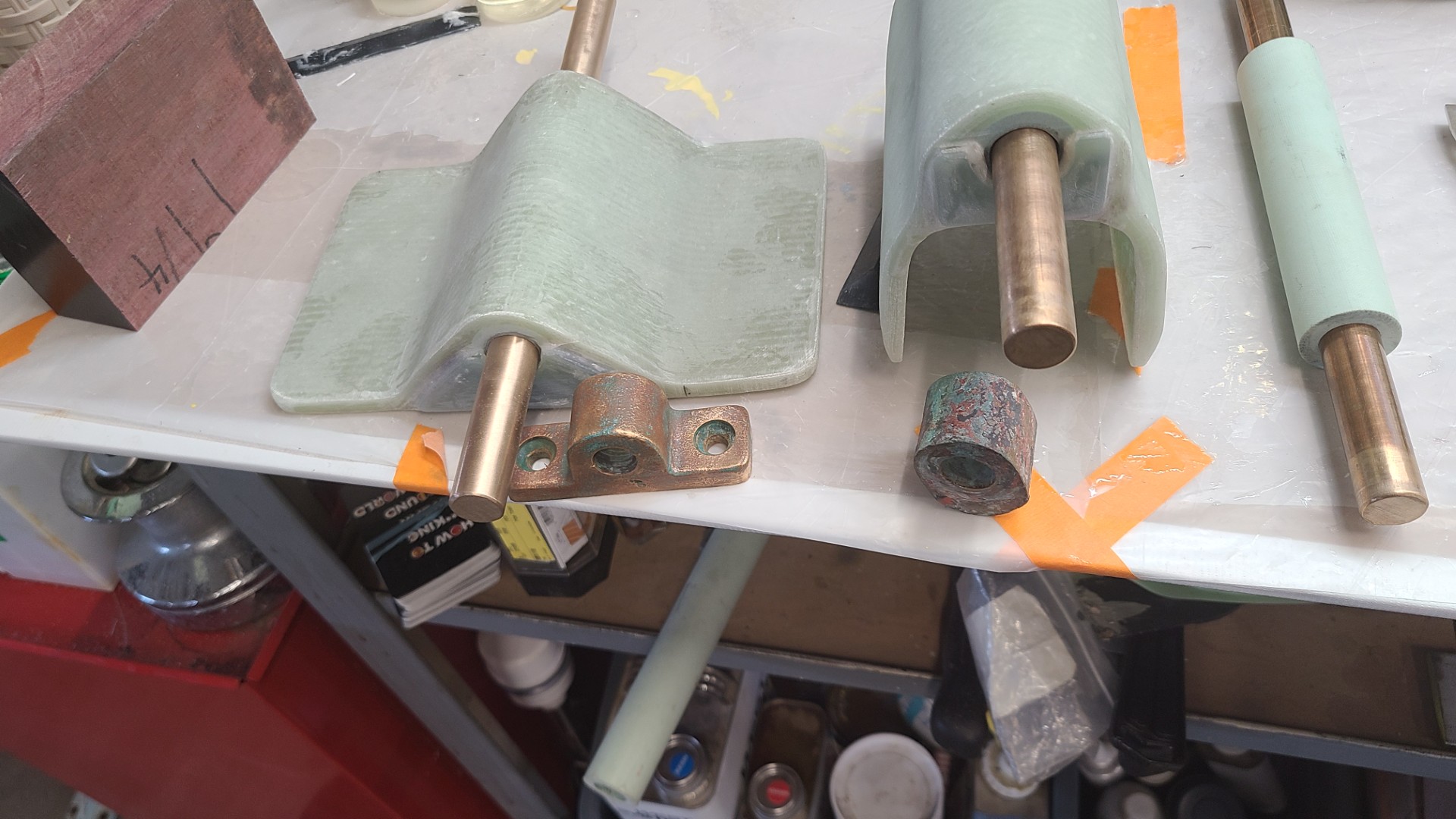
Finch’s old gudgeons, all two of them. The top one was flat mounted to the transom and the bottom one threaded into the hull with a 5/8″ silicon bronze stud. After building and installing the temporary rudder that let Finch get down Campbell River to Port Townsend, hauling out, and removing the temp rudder, I could finally inspect the situation that had until that point remained hidden below the water. The original rudder’s top pintle had been held captive by a 1/8″ thick 316 SS cotter pin, which had broken away in the impact and luckily spared the transom from any damage. The bottom gudgeon, however…. was bent. The entire piece had been bent upwards until the top of the gudgeon dug into the aft end of the keel, before presumably something else gave way and the rudder went to the bottom.


Luckily for us, that gives us a couple of measures to use to find out how strong the impact was! The 316 SS cotter pin is the easiest, so let’s start there. Shear strength of the annealed 316 Stainless Steel used for cotter pins is between 70,000 and 75,000 psi (pounds per square inch) and some simple math gives us a ultimate strength of that pin somewhere in the 861 to 922 lb range.
That’s a lot, eh?
There’s plenty of questions you could ask about if the cotter pin was old, mistreated, in contact with the bronze pintle for too long, or otherwise mistreated from previous (much smaller) impacts. Luckily, we’ve got a second data point, the bent bronze gudgeon stock!
The stock is a little trickier to get numbers for depending on the exact alloy and other factors but the fact that the shaft of the gudgeon bent but did not fail completely will give us a fantastic way to find a range of force that the impact would have been between. Silicon Bronze’s yeild strength, or when it will start to bend/deform, is around 50,000 psi and the ultimate (or tensile/failure )strength is around 85,000 psi. The 5/8 rod has an area of 0.31″ squared. A bit of rod bending calculations tells us that it would start to bend at 973lbs and fail at 1,654 lbs.
So, since the top edge of the gudgeon became supported by the back edge of the keel we can safely assume that the final force was somewhere in the upper end of that ballpark. 1600 lbs is a lot! A little more than the weight largest Polar Bear ever recorded, which is simultaneously impressive and also a bit of a let down. I want to hang multiple polar bears off of each of my gudgeons

So, when designing a new solution I hope to have something that can take a little more force. (now being measured in Metric Polar Bears). And I am, of course, pretty broke, so the more pricy options are off the table.
-Bent and welded stainless gudgeons, like the ones on the temp rudder, would last for a while but are very concerning long term (stainless steel crevice corrosion is not something I want to mess with).


-Cast Bronze gudgeons from local Port Townsend Foundry would be somewhere in the ballpark of $2400 as they’d need to be custom made
So….. the third option is….. fibreglass?
Don’t look at me like I’m crazy! Composite gudgeons aren’t especially common but have been used before, even in production boats. Westsail 32’s and 28’s for example either came with them stock or had them retro-fitted after their original stainless steel ones corroded away, and have an excellent reputation.
So, thanks to the wonderful, generous people that have contributed to the GoFundMe my partner Rachel set up for me (https://www.gofundme.com/f/help-liam-rebuild-finchs-rudder) I’ve got the materials and have started fabrication on some truly Polar Bear-worthy gudgeons.


I’m upgrading from 2 gudgeons to 3, and the bronze pintles that will eventually be held captive in the rudder are now 3/4″ diameter. Depending on if they’re the lower, mid, or upper, they’ll be through-bolted to the transom or bolted through the keel. The layup is….. thick. 11 layers of 6oz 45/45 biax around a G10 bearing tube as the contact point for the pintles, and purpleheart bearing blocks to keep everything faired nicely.
It probably all seems like overkill, but once you’ve run over a massive log and lost your rudder once? Ya kind of don’t want to do it again.
If you’re interested in more updates on the construction of these gudegons, seeing them installed, and the rest of the rudder build, let me know! And if you have a spare dollar or two to contribute to the cause, every one of those matters at this point. I still have the rudder itself to make!

Thank you to everyone who’s read this far, donated, talked with me to help figure out what I’m doing right or wrong, and helped out in all the other ways they can <3
-Liam